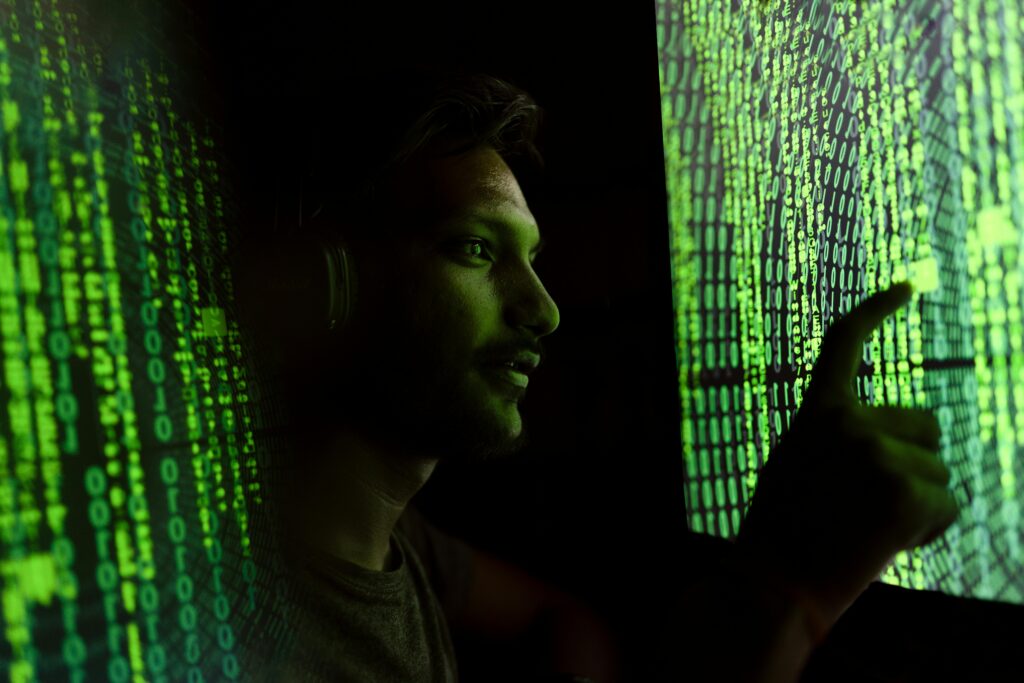
Technology changes fast. Identity changes slow—until, one morning, you catch your reflection in the screen and wonder who, exactly, is looking back.
Written by Pax Koi, creator of Plainkoi — Tools and essays for clear thinking in the age of AI.
The Long Blink Between Eras
In 1987, my father hovered over a beige box humming in the corner of our living room, gently coaxing Lotus 1-2-3 into submission while a dot-matrix printer screeched its way through a spreadsheet. It was the sound of patience, of progress, of something just mechanical enough to feel tame.
Thirty years later, I tapped open ChatGPT on my phone mid–grocery run. I started typing a thought about “the ethics of automation,” and the model not only completed the sentence—it offered counterarguments and a wry closer. The printer never did that.
If you pause and rewind through your own digital timeline, you can probably still feel it in your body: the warmth of a CRT monitor, the sound of a floppy clicking into place, the phantom buzz of a phone that never actually rang. These aren’t just memories—they’re coordinates in the slow, seismic shift of how we’ve fused with the tools we once only operated.
This is the story of that shift. Not just a tech timeline, but a human one.
We’ll trace three overlapping waves:
- The Operator Era (1980–1995): when we told the machine what to do.
- The Networked Era (1995–2015): when we connected—and complicated—the web of ourselves.
- The Reflective Era (2016–today): when the machine started answering back in our own voice.
And through it all: a central question. As the machine gets closer—more helpful, more humanlike—who do we become in return?
The Operator Era (1980–Mid-1990s): When We Told the Machine What to Do
Walk into an office in 1984 and you’d hear it: clacking keys, whirring fans, and the gentle ka-chunk of a floppy locking into place. Computers were newcomers—obedient, literal, and deeply limited. They sat beside fax machines like awkward interns, waiting for you to tell them exactly what to do.
Tools, Not Companions
Early software—WordPerfect, Lotus, Harvard Graphics—offered speed, not insight. They replaced typewriters and ledger paper, but they didn’t challenge your thinking. If something broke, you flipped through a manual that proudly called itself a “Bible.”
The computer was a tool. Not a collaborator. Certainly not a mirror.
We Were Operators
Our job was to know the syntax. To babysit backups. Creativity lived elsewhere—on whiteboards, in meetings, in the margins of notebooks. Computers were summoned for polish, not process. And we liked it that way.
Mood of the Moment
IBM’s “THINK” posters still lined cubicle walls. Tech promised mobility, but it felt optional—like taking a night class to stay ahead. Nobody feared being replaced by a machine. The real fear was irrelevance if you didn’t learn to use one.
Early AI Was a Gimmick
Programs like ELIZA mimicked therapists. Chess engines beat amateurs. But these were party tricks, not partners. AI was a lab curiosity, not a presence in your inbox.
Homefront Culture
At home, we blew dust out of NES cartridges, dialed into BBS boards, and felt like gods when we printed a banner that said “Happy Birthday.” Movies like WarGames whispered that even scrappy kids with modems could reshape the world.
Still, something was shifting. Typing classes went from secretarial electives to graduation requirements. People started asking: “If I can automate my spreadsheet today… what else will the machine learn to do tomorrow?”
That whisper—equal parts awe and apprehension—would echo through every era to follow.
The Networked Era (Mid-1990s–2015): When the Machine Became a Medium
If the Operator Era was about doing with machines, the Networked Era was about being with each other through them. And being seen.
The Web Walks In
Netscape Navigator made URLs feel like portals. Suddenly, you could ask questions and the ether would answer. Email replaced envelopes. Forums became social networks. The dial-up tone became the hum of global conversation.
We weren’t just using the machine anymore. We were inside it.
The Rise of the Digital Self
AOL screennames were our first avatars. MySpace let us rank friends. Facebook insisted on real names. Twitter shrank us to 140 characters. Every platform came with a built-in mirror: Who are you now, in pixels?
Attention Becomes Currency
The promise of information turned into the pressure of overload. Notifications became dopamine triggers. Feeds flattened time—cat videos, war footage, birthdays, and heartbreak all stacked in a scroll with no end.
Our inner lives began to sync with our screens.
Commerce Without Borders
Amazon made shelves vanish. PayPal removed friction. Netflix turned DVD deliveries into streaming spells. We didn’t just shop online—we lived there. Waiting became quaint. On-demand became default.
The Smartphone Tipping Point
Then came the iPhone.
The internet wasn’t something you checked. It was something you carried. You didn’t just go online—you stayed there.
Maps spoke. Food arrived. Love was an app. Our fingertips became remote controls for the physical world. The expectation wasn’t just convenience. It was control.
The Social Reckoning
But control had a cost.
Teen anxiety surged as perfection became performative. Algorithms nudged politics toward extremes. Connection no longer guaranteed closeness.
What began as liberation began to feel like saturation.
Borders Dissolve
Cloud tools let teams span continents. A coder in Nairobi could ship for a startup in Nashville. Remote work wasn’t a trend—it was a feature. Geography stopped defining access. Talent floated free.
The premise had shifted: technology wasn’t just a tool. It was the tissue holding us together—and, increasingly, pulling us apart.
The Reflective Era (2016–Today): When the Machine Started Answering Back
In November 2022, something quiet—and seismic—happened. A beta release called ChatGPT opened to the public.
At first, it felt like a better autocomplete. Then it started finishing jokes, solving math problems, writing haikus. It remembered tone. It offered condolences. It hallucinated facts with the confidence of a TV pundit.
It wasn’t a search engine. It was a mirror—trained on all our words, and ready to reflect them back.
From Tool to Creative Partner
Large language models stopped just predicting the next word. They started generating: stories, business plans, breakup letters. Midjourney painted impossible cities. Sora conjured videos from prompts. Autonomous agents proposed running companies while we slept.
The machine didn’t just follow. It improvised.
Mirror, Mirror
Prompt: “Write me a marketing email in the voice of Shakespeare.”
Response: A sonnet extolling thy limited-time offers.
The magic wasn’t in the machine—it was in the prompt. The clearer the question, the clearer the mirror. Which meant the real art was in the asking.
New Dilemmas
This mirror, though, has edges.
AI can ace the bar exam and fabricate legal citations in the same breath. It can mimic your grandmother’s voice—or your worst instinct. It raises questions with no precedent: What’s authentic? Who’s accountable? And what happens when dependency feels easier than deliberation?
Case Studies in Co-Creation
- Newsrooms use AI to draft earnings reports in seconds—until one bad stat moves markets.
- Radiologists use AI heat maps—but warn against overtrusting its guesses.
- Novelist Robin Sloan calls his AI “a saxophone that sometimes improvises better than me.”
We’re no longer just prompting tools. We’re collaborating with personalities.
Economic Undercurrents
The World Economic Forum predicts 44% of workers will need reskilling soon. Meanwhile, ten-person startups outperform 50-person departments.
AI isn’t just a creative partner. It’s a force multiplier—and a threat to business as usual.
Regulation and Resistance
Lawmakers draft the EU AI Act. Screenwriters strike against synthetic actors. Open-source communities demand transparency. The boundaries are blurry. The stakes are real.
The premise now? Technology as co-creator—powerful, personal, and deeply reflective of whoever happens to be holding the mirror.
Who Are We Now?
With each new interface, we didn’t just adapt our workflows—we reshaped ourselves.
But some things didn’t shift as fast.
Contextual Empathy
We still catch the tremor in a friend’s voice no sensor can hear.
Cross-Domain Intuition
We compare love to gravity. We blend cuisine with code. We build metaphors models can’t quite follow.
Moral Imagination
We picture futures and decide which ones are worth building—and which should never happen.
The machine doesn’t do that. We do.
The Psychological Pivot
When AI finishes your sentence—do you feel understood or replaced?
People pour confessions into chatbots they wouldn’t share with partners. We offload not just tasks, but emotion. That’s not just convenience. That’s transformation.
Rethinking Education
If memorization is obsolete and synthesis is augmented, then what is learning for? We’re entering a world where students must learn not just with AI, but despite it. Where reflection becomes more vital than recall.
The next frontier in education isn’t content. It’s coherence.
Closing: The Mirror Doesn’t Lie—But It Doesn’t Lead Either
We’ve moved from command lines to conversations. From machine obedience to machine improvisation.
But here’s the twist: every time the machine got smarter, it got more dependent on us.
It echoes our tone. It borrows our biases. It mirrors our intent, our clarity, our confusion. It reflects us—sometimes too well.
And that’s the challenge now. Not to outpace the machine. But to outgrow the version of ourselves it currently reflects.
Because in the next wave of human–AI co-creation, it’s not just about what the technology can do. It’s about who we choose to be while using it.
And that answer? Still only comes from us.
A Note of Gratitude
This article was shaped in part by the work of Sherry Turkle, whose research on human–technology relationships has spanned decades. More at sherryturkle.com.
Written by Pax Koi, creator of Plainkoi — Tools and essays for clear thinking in the age of AI — with a little help from the mirror itself.
AI Disclosure: This article was co-developed with the assistance of ChatGPT (OpenAI) and Gemini (Google DeepMind), and finalized by Plainkoi.
© 2025 Plainkoi. Words by Pax Koi.
https://CoherePath.org
